Your cart is empty.


Your cart is empty.
Festival City Stories 11 Jul 2024

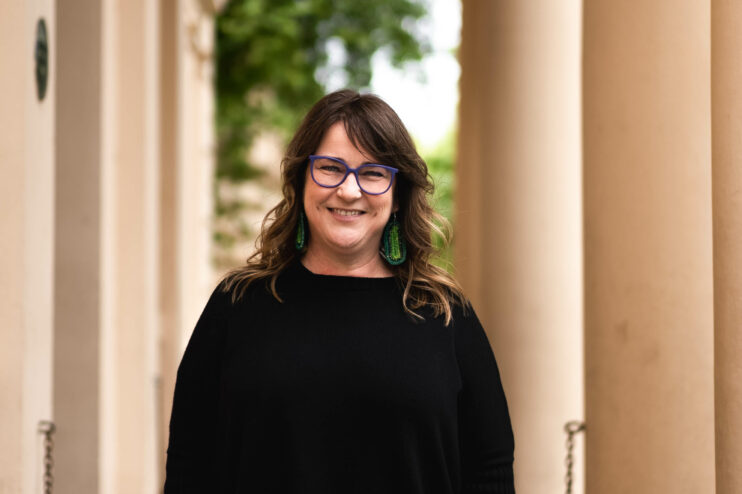
“The strongest memory I have from an Adelaide festival is going with my mum to see Bangarra Dance Theatre’s Ochre and Dust” says Nici Cumpston OAM, Curator of Aboriginal and Torres Strait Islander Art at the Art Gallery of South Australia, and the Artistic Director of Tarnanthi Festival of Contemporary Aboriginal & Torres Strait Islander Art. “We were close to the front row, and I remember getting ochre on me from the dancers. It was just one of the most beautiful experiences.”
Nici has spent most of her life connected to diverse modes of cultural expression. Born in 1963 in Tarntanya/Adelaide, Nici’s family is of Afghan, English, Irish and Barkandji Aboriginal heritage, and she is a descendant of the Darling River people of north-western so-called New South Wales.
She recalls that the significance of art was impressed upon her early: “I think I was lucky that mum and dad took us to many different plays and different events…we had original works of art in our house because my mum loved art, so it was something I grew up with.” She first learned to develop films and prints with her father, a radiographer by day who developed his own black-and-white photography during spare moments. “I was his assistant in the darkroom when I was little!” Nici says with a smile.
Her career in art didn’t follow a predictable route: upon completing high school, Nici studied nursing and worked in the sector for a number of years.
Curious to try something else, she returned to study—this time, Fine Art Photography, which was followed by an Honours Degree. She taught at Tauondi College for 10 years, lecturing in Photography, and co-managing the art department. Next was University of South Australia, where she wrote and delivered the inaugural course on Indigenous Art, Culture and Design. In 2008, she was offered an exciting opportunity at the Art Gallery of South Australia (AGSA) as a curator.
“One of my first tasks was coordinating the exhibition ‘Cultural Warriors,’ which was the first national Indigenous triennial from the National Gallery of Australia. It had just shown in Canberra and we were the first touring venue…It was a really steep learning curve but fascinating work. I appreciated the opportunity to work with art by incredible artists who I had studied through art school and never imagined I would be handling!”
In 2013, Nici was approached by the then Director of AGSA, Nick Mitzevich, to take on a new project, though details at first were not disclosed. “He didn’t really elaborate. We didn’t know what it was going to be yet….”
The project was to become Tarnanthi, a celebration of Aboriginal and Torres Strait Islander art which has transformed Tarntanya/Adelaide’s arts and festival calendar.
Alongside arts worker Mimi Crow, Nici initially spent four months in conversation with Kaurna Elders at Kaurna Warra Pintyanthi at the University of Adelaide, discussing ideas and form, including the name that the nascent festival could take. In these conversations, the Kaurna word ‘tarnanthi’ arose: “‘Tarnanthi is a word that means the first light of day or the sight of a seed sprouting.”
It was consumerrate with the spirit of the festival, and so Tarnanthi 2015 was born.
Developing the festival in consultation with Kaurna Elders was critical to Nici. “I think if you’re creating something on someone’s Country, it’s essential to speak to them about that and to determine the best way forward.”
The festival was to be a site for storytelling, for sharing and expanding diverse ideas, voices, and practices. “As Aboriginal people, we have so many different stories to tell,” Nici says. “I didn’t want to have anything that was thematic because I felt that would be restricting.” Through Tarnanthi, Nici hopes that artists’ perspectives are centred and listened to, and that ambition is extended through new possibilities
“Tarnanthi really was about providing new opportunities. It is about supporting artists to be their best and to give them opportunities that might otherwise have not been available.”
Alongside her curatorial work, Nici has an acclaimed artistic practice, with her work held in the collections of the National Gallery of Australia, National Gallery of Victoria, Parliament House, Flinders University Art Collection, the Adelaide Festival Centre Foundation, among many others. She focuses on photography, expressing through the medium an intimate relationship with Country.
“It’s really about feeling, listening, looking and hearing Country,” she says. “Country is so important. It’s who we are as people. Our Country tells us what we need to know. And so, therefore, in my work, I’m mainly creating works from Country.” She often works with medium-format cameras and finds herself drawn to the feelings of sanctuary and focus that she first encountered in the darkroom.
“I work with black-and-white film, and then have the film developed. I enlarge those images and hand-colour them. And that’s my way of going back into that sort of meditative state that I used to find myself in.”
Nici is preparing for a busy time ahead. Tarnanthi runs from 20 October 2023 – 21 January 2024, and she will continue weaving her multiple practices of art, writing, and pedagogy.
To conclude our conversation, I ask if there is a festival that she would like to see brought to the city that doesn’t necessarily exist yet?
“I would love to see an international First Peoples film and performance festival,” Nici says enthusiastically. “I think that would be amazing. I have friendships with people on Turtle Island (Canada) and the U.S, and Sami people in the north of Scandinavia. It would be wonderful to have people from other parts of the world come together: we’re different but we have a lot of similarities, and much would be gained from that cultural exchange.”
_________________________________________________________________________________________
This article is part of the Festival City Stories series, a collection of reflections about Adelaide made by the people who make this a festival place. The project was funded through the Department of Premier and Cabinet, Arts South Australia, Arts Recovery Fund, and delivered in partnership with the State Library of South Australia.
Written by: Ena Grozdanic
Photography by: Declan Hartley-Brown