Your cart is empty.


Your cart is empty.
Festival City Stories 11 Jul 2024
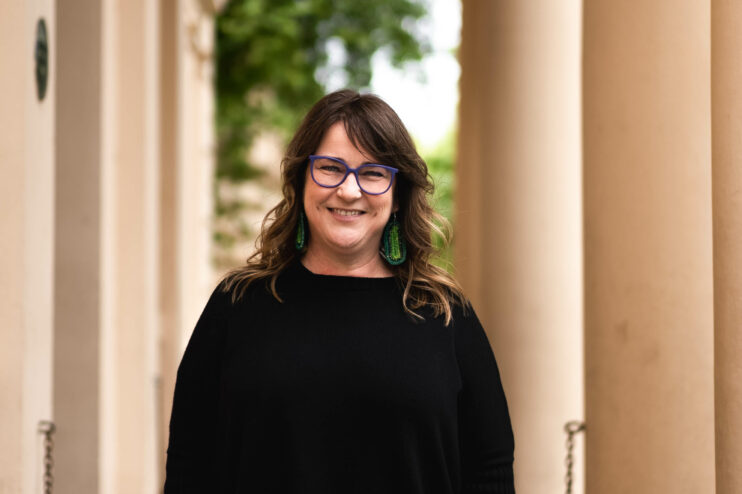
Michelle Smith can still vividly recall the night she first experienced the transformative power of live music. The primary school teacher and host of Radio Adelaide’s Rhythm Stick show was just 12 years old when her parents took her to see the Jackson Five in 1974 and her memory of that night is a blur of flares, boleros, disco lights, seamless choreography and “wanting to scream but not being allowed to because my parents were next to me.”
In the decades since, Smith’s has significantly expanded her musical knowledge by working in radio, travelling the world and attending WOMADelaide (which she has not missed since its second year in 1993). For four days every March, she joins the crowds beneath sprawling Moreton Bay Fig trees in Adelaide’s Botanic Park and immerses herself in the diverse musical sounds of WOMADelaide.
Over the years Smith has attended as an audience member, a radio presenter and – since 2000 – in her volunteer position as an artist-minder, welcoming musicians from every corner of the globe to Adelaide. This role has seen Smith rub shoulders with global music icons, including personal idols such as Beninese singer-songwriter Angélique Kidjo, who she met when Kidjo headlined in 2019.
The late folk music star Richie Havens – most famous for opening Woodstock in 1969 – left a lasting impression when he visited shortly after Smith’s mother died in 2010. Sharing stories from his life, of walking down 1960s New York City streets heaving with poets and casually bumping into the likes of Bob Dylan provided an unexpected, inexplicable comfort. “I’ve never met a more charismatic person who was also so grounded … his energy stayed with me for about six weeks after that festival. I was conscious of this lovely, lovely presence.”
That same year also brought legendary Indian sitar player Ravi Shankar, who appeared alongside his daughter and fellow sitarist Anoushka Shankar. Smith recalls watching from side stage with the elder Shankar wrapped in a blanket, the cool evening breeze catching his snow-white hair as Anoushka played. When he joined his daughter on stage, his wife Sukanya turned to Smith. “She said, ‘Not bad for nearly 90,’ in this beautiful Indian accent. And then she turned back again: ‘I like your earrings, by the way.’”
Since her first encounters with live music and festivals almost fifty years ago, Smith has watched Adelaide come into its own as the Festival City. She describes “witnessing the evolution” of Adelaide festivals as they have grown in size and number to include an astonishing variety of performances and audiences. And looking forward, she hopes that her hometown can continue driving new ideas without losing sight of the bold, original programming built by the elders in the arts.
It’s a spirit that is alive and well every time WOMADelaide lures devotees to gather with a community of like-minded people and open their ears to a chorus of music from all corners of the globe. “A lot of people, unfortunately, have a very limited view of which kind of cultures are valuable and which ones are not,” Smith concludes. “I think any opportunity to dispel myths about that [is] important. It’s a bit of a cliché, but I think music and the arts really [do] have that capacity to open people’s ears.”
_________________________________________________________________________________________
This article is part of the Festival City Stories series, a collection of reflections about Adelaide made by the people who make this a festival place. The project was funded through the Department of Premier and Cabinet, Arts South Australia, Arts Recovery Fund, and delivered in partnership with the State Library of South Australia.
Written by: Sarah Couper
Photography by: Thomas McCammon