Your cart is empty.


Your cart is empty.
Festival City Stories 11 Jul 2024

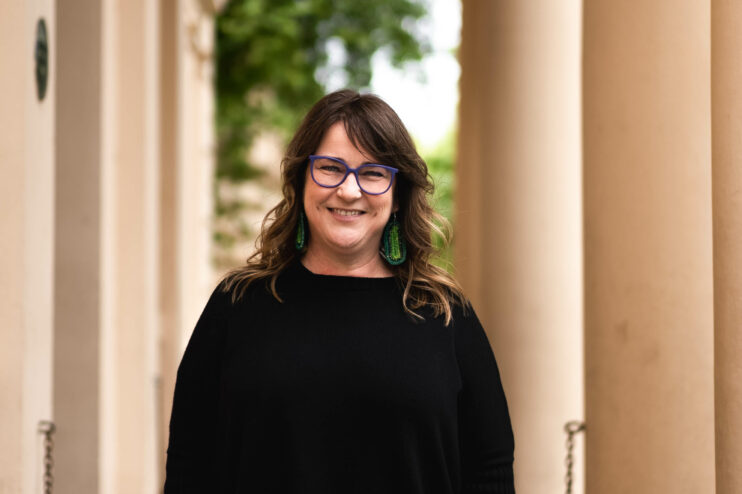
‘Feast is like the auntie or uncle that just completely allows you to be you, that lets you wear clothes to bed or lets you have ice cream for breakfast – that is Feast Festival,’ says Kukatha / Wirangu / Kaurna / Ngarrindjerri woman Bel Mac.
Belinda McKeown grew up an army brat, moving almost every year of her life and succumbing to bullying by classmates due to the colour of her skin.
Working toward a Diploma of Aboriginal Studies, at 19 she fell pregnant with her second child and had to stop studying, had to work, and often did so through organisations driven by the recognition and advancement of her people.
When Bel was still very much in the closet, she was asked to perform stand-up comedy at Feast Festival’s Aboriginal showcasing that later became known as Nungay Night, on the basis that her brother was gay and she was an ally. Finding her people while finding herself, she eventually began running it.
Still, she sometimes felt not Aboriginal enough, not gay enough, completely out of her depth, and she questioned her sanity.
But on opening night, while one of the dancers performed their soundcheck, Bel thought ‘This! This is why I’m doing it. I’m doing this so that my community can have a stage. I’m doing this so that people who don’t get the light can stand in the light. Even if it’s just for one night, that’s what I’m doing it for.’
Having special needs children and extended family members means her community is multi-faceted: ‘I always make sure that there is wheelchair access. I always make sure that there is a chair for an elder or someone who can’t stand. I always make sure that it is a safe space, because not only to be safe on an LGBTIQA+ level but safe from an Indigenous level, First Nations, Torres Strait Islander.’
In 2022 Bel was named NAIDOC LGBTQI+ Person of the Year as well as Feast Festival’s ambassador.
With Feast she’s been a producer, coordinator, artist and audience participant. She says her next step is to teach others in the space.
Mentoring an up-and-coming Aboriginal and Torres Strait Islander could set her up in a way that might eliminate much of the 4am texts and emails that go with the job.
It’s about ensuring longevity. ‘People are learning who they are at Feast Festival because that might be the only time they’re allowed,’ she says from personal experience, and it’s important.
‘People are growing, people are falling in love, people are breaking up, people are gossiping, people are laughing, people are crying. It is the festival that giveth.’
But it’s no Sydney Mardi Gras, where the entire city gets on board, because outside of the rainbow community, many are completely unaware of Feast, even though it’s been a staple in our festival calendar since 1997. She says Feast is for all the people.
Like NAIDOC Week, ‘it’s not just for Aboriginal people, it’s for all the people. It’s our culture. It’s this country’s culture. Feast Festival, it’s a part of humanity.’ She suggests standing in an open-back truck, with her voice blasting through a megaphone as a way to get the word out, big thinking she likens to Priscilla, Queen of the Desert, and though she might be talking cheekily, it’s this kind of thinking that’s so often paid off in her productions.
She gets the icicle lights, the mannequins and the photo booths large enough for 7-foot drag queens because she’s got the vision and the gumption to insist, and because she prioritises relationships.
It’s all about a very vocal dialogue. ‘Get people talking more,’ she says in response to promoting Feast.
‘I think it can be faced with some adversity, but it’s still a conversation that needs to happen and should happen.’
_________________________________________________________________________________________
This article is part of the Festival City Stories series, a collection of reflections about Adelaide made by the people who make this a festival place. The project was funded through the Department of Premier and Cabinet, Arts South Australia, Arts Recovery Fund, and delivered in partnership with the State Library of South Australia.
Written by: Heather Johnson
Photography by: Chi Catalano